
Cladding in Hunstanton
The only resort on this coast that faces west, so the weathering face and the sun face are the same elevation. What that changes about the specification.
Areas · Norfolk coast
Cladding installers working the Norfolk coast, from King's Lynn and the Wash round through Wells-next-the-Sea to Cromer. Free site visit, and a written estimate that sets out the build up behind the boards, not just the boards.
This is the hardest coastline in the east of England to clad a building on, and it is the one AJB Group has done its two largest cladding jobs on: over 350 square metres of Scottish larch at Cromer, and the full exterior finish package at Wells-next-the-Sea.
Cladding on the coast is not the same product as cladding twenty miles inland. The boards are identical. Everything else changes: the fixings, the membrane, the cavity, the coating decision, the species and how quickly the seaward face stops looking like the sheltered one. Most of what goes wrong here goes wrong behind the boards, where nobody looks until it is too late to be cheap.
Proof
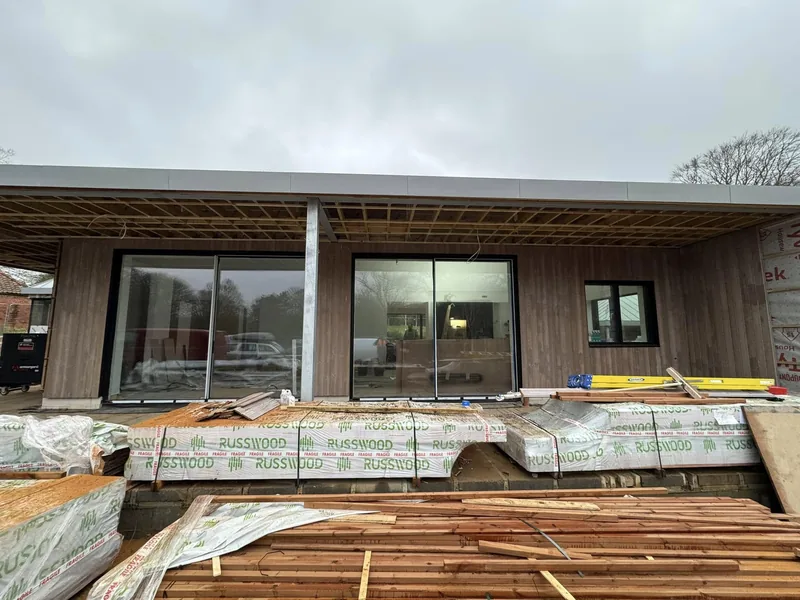
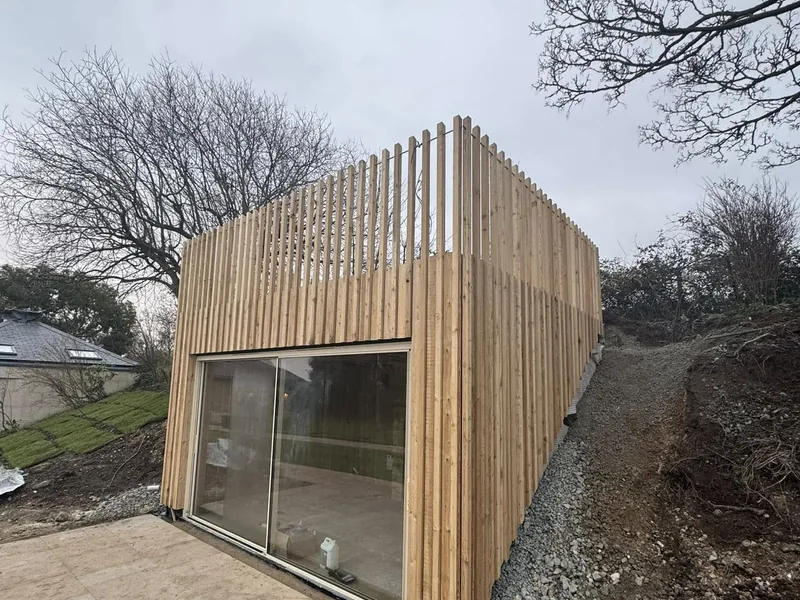
Cromer: over 350 square metres of Scottish larch. A new build on the Norfolk coastline at Cromer, clad in Scottish larch across the whole envelope. Exposure at Cromer is about as hard as it gets in this part of the country: salt carried in off the North Sea, wind with nothing between it and the building, and full sun on the seaward elevations.
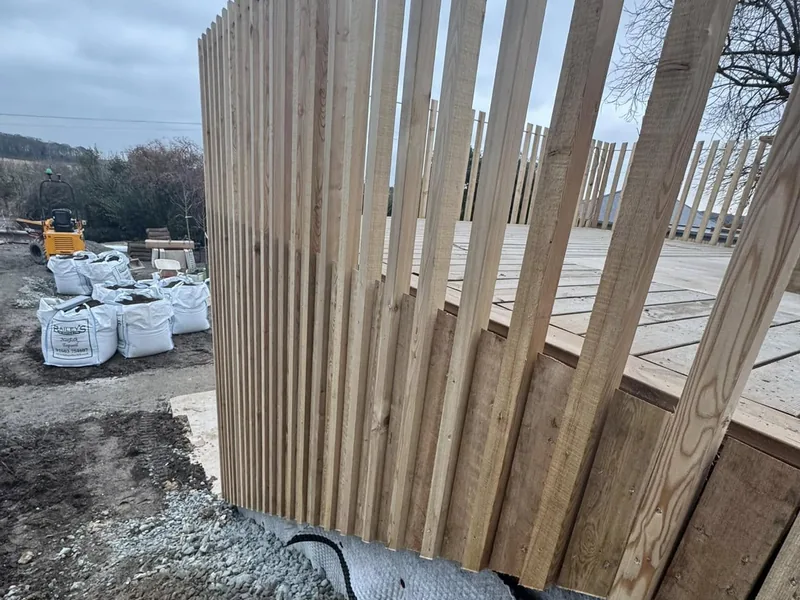
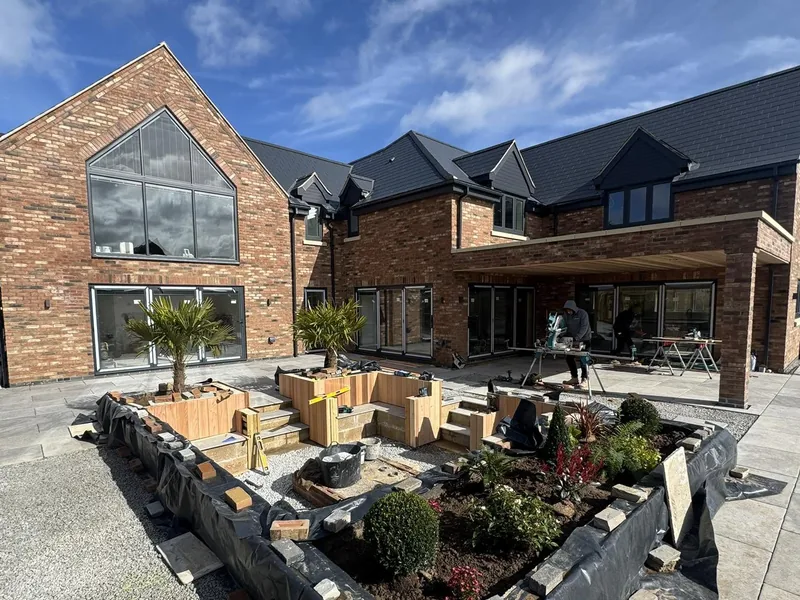
Wells-next-the-Sea: Snuggle Cottage, circa £1.8M. AJB was entrusted with the exterior finish package on this build: full exterior cladding to both properties, plus a watch tower built to overlook the sea. The tower was machined up on site by our own joiners from packs of loose sawn Scottish larch, against what the team described honestly at the time as a very questionable plan from the architects. Internally it was constructed with PIR boards, battened out and finished in oak faced cladding so the room can be used all year rather than in summer only.
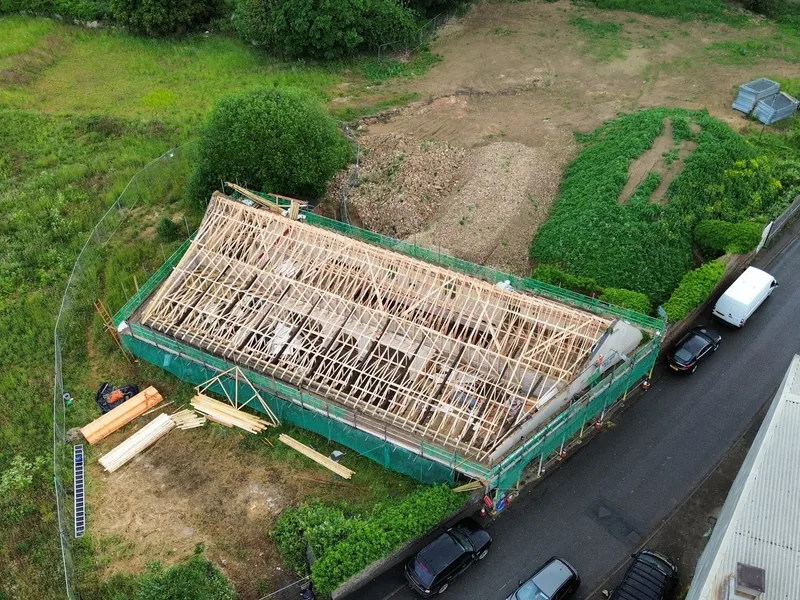
Stoke Ferry Village Hall. Inland but firmly in Norfolk: a full strip back and replacement of the roof on the village hall, finished with a brand new trussed roof, sequenced around a hall that had a busy diary to keep.
King's Lynn. A full barn conversion for Eastern Construction Consultants with a traditional joist set forming a new first floor, and before that the full carpentry contract on 7 two and three bed apartments at South Lynn.
Architectural roofs, for Grocott & Murfit. Bespoke architectural roof structures on the Norfolk coast for a developer, on designs the team noted were not the sort you see every day.
The technical part
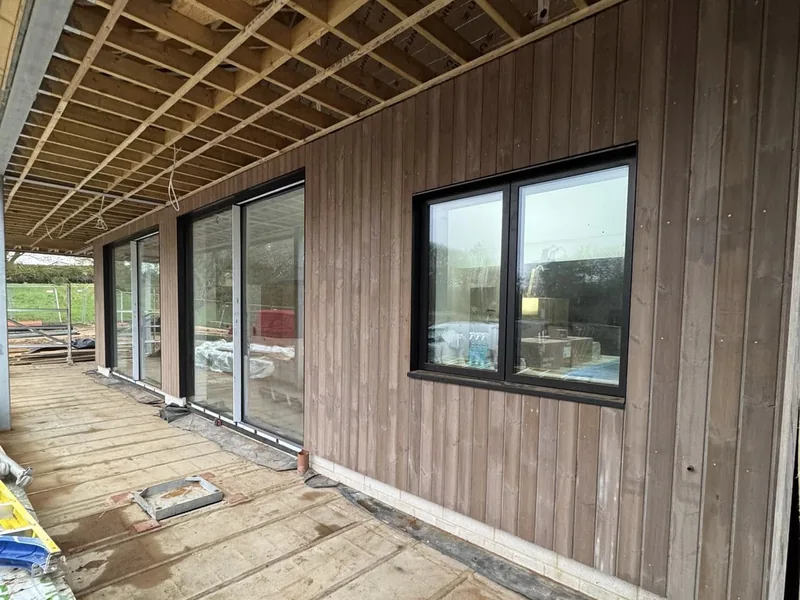
Salt. Airborne chlorides attack fixings first. On a coastal elevation A2 304 stainless is not enough: it pits and eventually bleeds, leaving a rust tear under every fixing head down an otherwise perfect wall. A4 grade 316 is the correct call within roughly a kilometre of the sea, and it is a small proportion of the job cost against the price of taking a wall back off.
Wind driven rain. North Norfolk is flat, open and unwooded, so there is nothing to slow the weather down before it reaches your elevation. Cladding is a rainscreen, not a waterproof layer: water will get past the joints, and the only question is whether the wall behind can dry. That is the whole argument for the ventilated cavity, the breather membrane and openings at both the base and the head, and it is the first thing skipped when someone prices a job cheaply.
Sun and silvering. Untreated larch and cedar go silver. That is not a fault, it is the timber doing what it does, and on a coastal build it is often the right answer because a silvered wall needs nothing done to it. What does surprise people is that it does not happen evenly: the seaward and sunward elevations grey out first and hardest, and a sheltered north face can stay warm brown for years. If an even colour matters to you, that is an argument for a pigmented UV stable coating and a maintenance cycle you commit to, or for a composite board.
Movement. Coastal timber gets wet and dries fast, repeatedly. Boards have to be fixed to move: fixings positioned to allow it rather than to restrain it, boards up to about 100mm face width taking a single central fixing per batten and wider boards taking two, and end grain sealed before the board goes up rather than after.
Materials
Each page below sets out durability, movement, fixing method and what maintenance you are actually signing up for.
Towns along the A149
Cromer and Wells-next-the-Sea are where the jobs are. The pages below cover three more towns along the same coastline, and each one says plainly whether AJB has worked there or not.
The only resort on this coast that faces west, so the weathering face and the sun face are the same elevation. What that changes about the specification.
Conservation area inside a National Landscape, so cladding a house needs permission. What tends to sit well on brick, flint and pantile.
Ten miles inland, on the road between our Cromer and Wells jobs. Lower salt loading, same exposure, and a different planning position.
Getting to you
AJB is based in Spalding, about 30 miles from King's Lynn on the A17 and then out along the A149 and A148 for the coast. Cromer is roughly 75 miles, Wells about 55, Hunstanton about 46. Those are real distances and worth being straight about: this is not a same day call out service, it is package work with a defined start and finish, quoted with the travel in it and programmed properly.
What that buys is a contractor who has already clad 350 square metres on the most exposed part of this coastline, has its own crane, employs fourteen carpenters and is CHAS accredited and SMSTS certified. AJB also holds a fire door contract with North Norfolk District Council and has taken on work at Stoke Ferry and King's Lynn, so Norfolk is worked territory rather than an occasional excursion.
Case studies
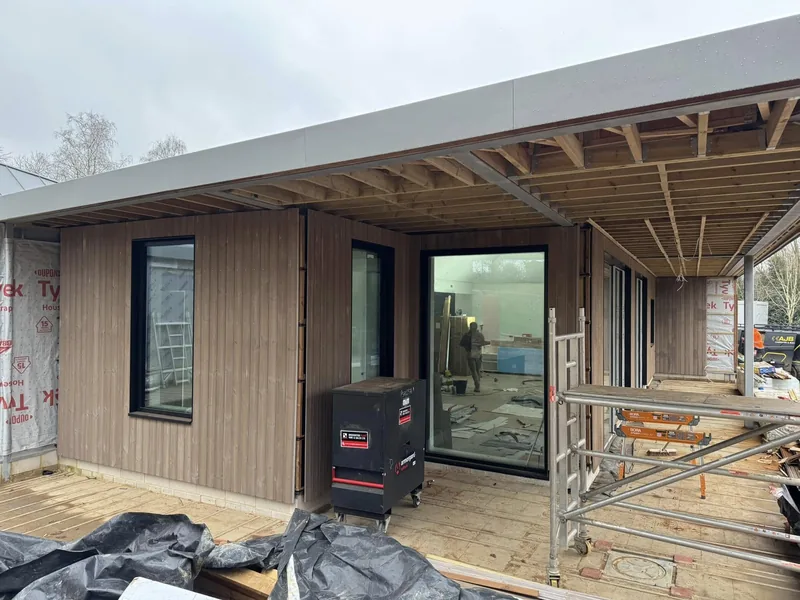
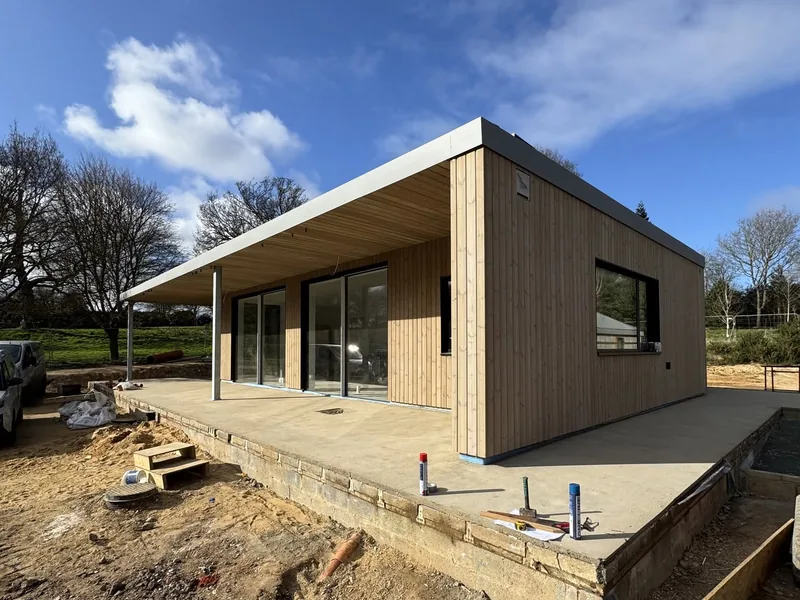
Over 350 square metres of Scottish larch on a new build on the Norfolk coastline, on the most exposed stretch of coast AJB works.
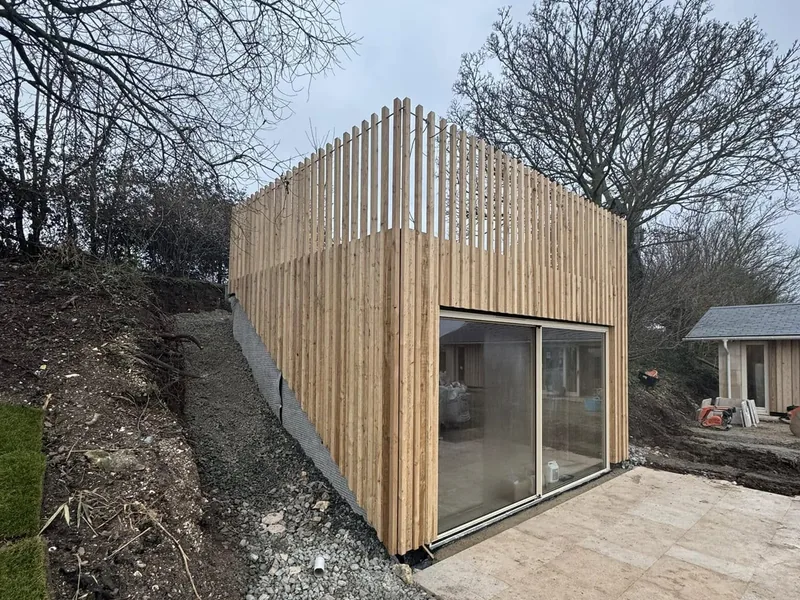
The exterior finish package on a circa £1.8M build: full cladding to both properties plus a sea view watch tower in Scottish larch, lined with PIR and oak faced cladding.
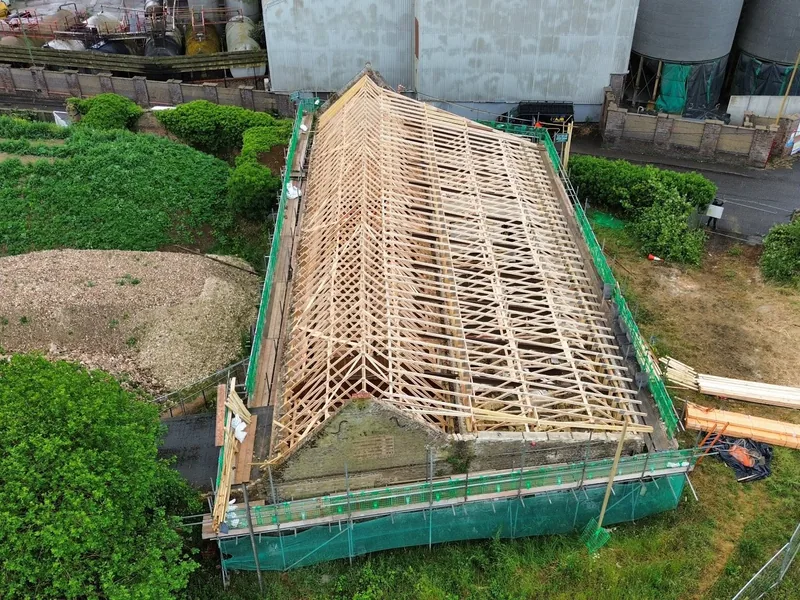
A full strip back and replace of the roof on a Norfolk village hall, finished with a brand new trussed roof around the hall's own schedule.
Common questions
Cromer, where we fitted over 350 square metres of Scottish larch on a new build, and Wells-next-the-Sea, where we held the exterior finish package on a circa £1.8M build including full cladding to both properties and a sea view watch tower. Inland there is a new trussed roof on Stoke Ferry Village Hall, and a barn conversion plus an apartment scheme at King's Lynn.
Three things above all. Fixings move from A2 304 stainless to A4 316 stainless because of chlorides in the air. The ventilated cavity and breather membrane behind the boards matter more, not less, because wind driven rain gets past the joints on exposed elevations. And the weathering face silvers and breaks coatings down far faster than the sheltered faces, so the finish decision belongs to the elevation, not the building.
There is no single answer, only a sensible one per elevation. Scottish and Siberian larch are dense and moderately durable and are what we have used most on this coast. Western red cedar is more stable and lighter but softer. Thermally modified timber and wood plastic composite both trade character for a longer maintenance interval, which suits holiday lets where nobody is going to re-coat anything.
Often yes. Cladding the exterior of a house is excluded from permitted development on land in a conservation area, a National Landscape, a National Park, the Broads or a World Heritage Site. Much of this coastline falls within the Norfolk Coast National Landscape and many of the villages have conservation areas, so check with the local planning authority before assuming anything.
The whole of it. We work from King's Lynn round through Hunstanton, the Burnhams, Wells-next-the-Sea and Blakeney to Sheringham and Cromer, roughly 70 miles of coastline. Cladding is package work with a defined start and finish, so distance is a programme question rather than a barrier.
No. Site visits and written estimates are free, and on a coastal elevation the visit is worth having: the exposure, the orientation and the state of the existing wall all change what should be specified behind the boards.
Free site visit, and an estimate that specifies the cavity, the membrane and the fixings, not just the boards.