
Cladding · Western red cedar
Western red cedar cladding
Western red cedar cladding installed across Lincolnshire, Cambridgeshire and Norfolk, on houses, extensions, retail units and garden structures. Durable heartwood, the most stable common cladding timber, fixed with stainless steel over a ventilated cavity. Free site visit and a written estimate before anything starts.
What cedar is good at
The most forgiving cladding timber, and the one that punishes the wrong fixing.
Western red cedar earns its place on three properties. Its heartwood is classified as durable, so it survives outside untreated. It has an unusually small movement class, so boards stay flat and joints stay tight where other timbers cup and open. And it is light for its size, which matters on a large elevation and on anything craned or lifted into place.
Add a straight, clean grain with relatively few defects in the better grades, a timber that machines beautifully and takes a coating evenly, and you have the species architects reach for when the detailing is fine, the joints are close and the elevation has to look precise. It is why cedar suits secret fixed tongue and groove and narrow board on board detailing where a knottier, wetter timber would fight you.
What cedar is not good at is taking knocks. It is a soft timber. At low level on a busy elevation, next to a bin store, along a car park edge, it dents and scars where larch would shrug it off. On those elevations we will normally suggest larch instead, or cedar above and something tougher below.
The acid problem, and why fixings are not negotiable
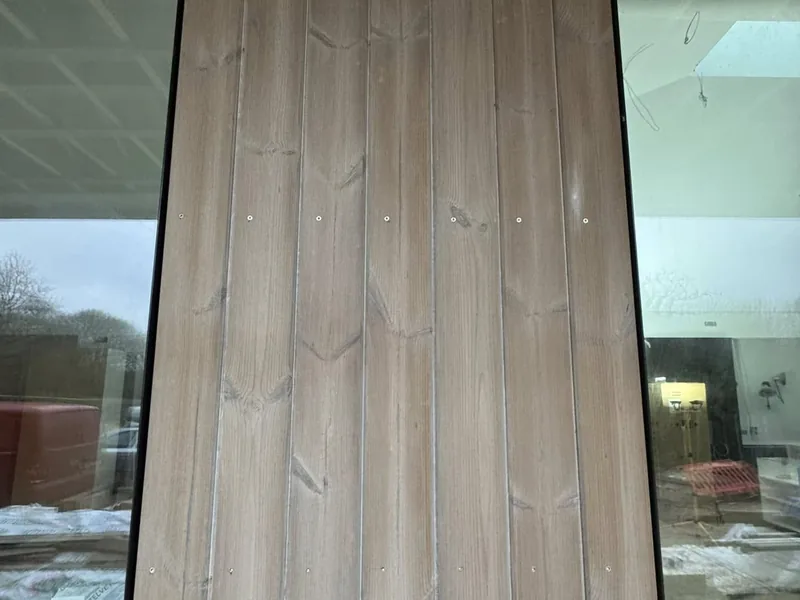
Cedar contains natural acids and extractives. They are part of why it is durable, and they are also why it attacks metal. Ordinary steel fixings rust in it. Galvanised fixings lose their coating and then rust in it. The result is a fixing that gradually loses its grip, and a black tear stain running down the board from under every head, which is the single most recognisable sign of a cedar job done cheaply.
So: stainless steel only. A2 grade 304 inland, A4 grade 316 on the coast and on heavily exposed elevations. The same goes for any flashing, trim, bracket or fastener that touches the timber, and for anything sitting below the cladding that runoff will land on, because cedar runoff will stain masonry and light render.
Western red cedar at a glance
- Durability
- Heartwood classified as durable. No preservative treatment needed for external use above ground
- Movement
- Small movement class, the most dimensionally stable common cladding timber
- Weight
- Light for its size, which helps on large elevations and lifted panels
- Hardness
- Soft. Dents and scuffs at low level, so consider a tougher timber below waist height on busy elevations
- Fixings
- Stainless only, A2 inland and A4 coastal. Never galvanised, never bright steel
- Profiles
- Feather edge, shiplap, tongue and groove, board on board, square edge open jointed
- Weathering
- Warm red brown to silver grey if left uncoated, unevenly and elevation by elevation
- Coating
- Takes a UV stable pigmented oil well. Coat all four faces before fixing, plan to recoat every two to three years
Cedar we have installed
A national coffee brand, an extension, and a garden fire pit
Costa, Hemsworth retail park
We were entrusted to clad the exterior of a new retail park unit in Costa's 2022 national design, bringing a Costa and a KFC to Hemsworth. The drive thru section was clad in British red cedar, described by our own team at the time as very fiddly work and well worth the view. A brand rollout specification with a fixed opening date behind it is a good test of whether a cladding gang can hold detail under programme pressure.
Cedar wrapped extension
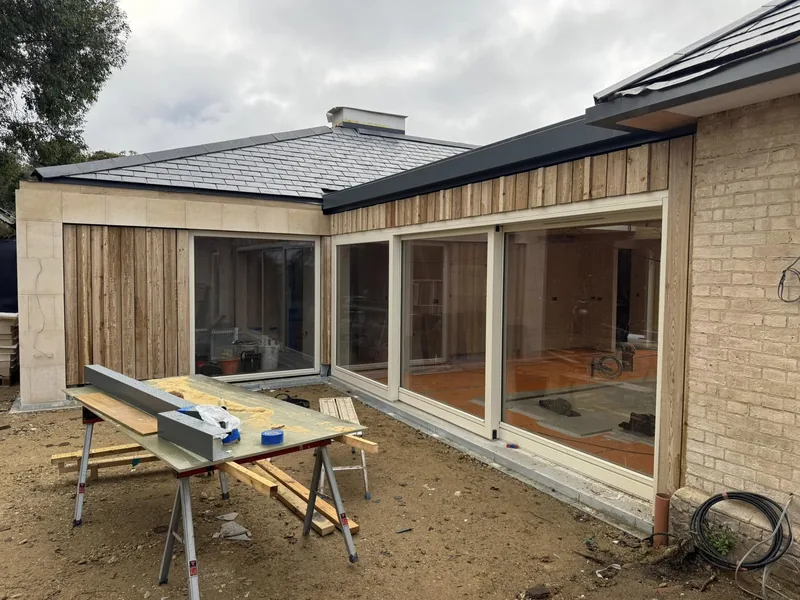
A timber frame front and rear extension completed over a summer and wrapped in cedar cladding to finish it, working alongside NJB GroundWorks who handled the footings and patio. On a job like that the cladding is the part everybody sees, and it is doing a second job of tying a new structure visually to an old house.
Fire pit structure for SSL Home Creations
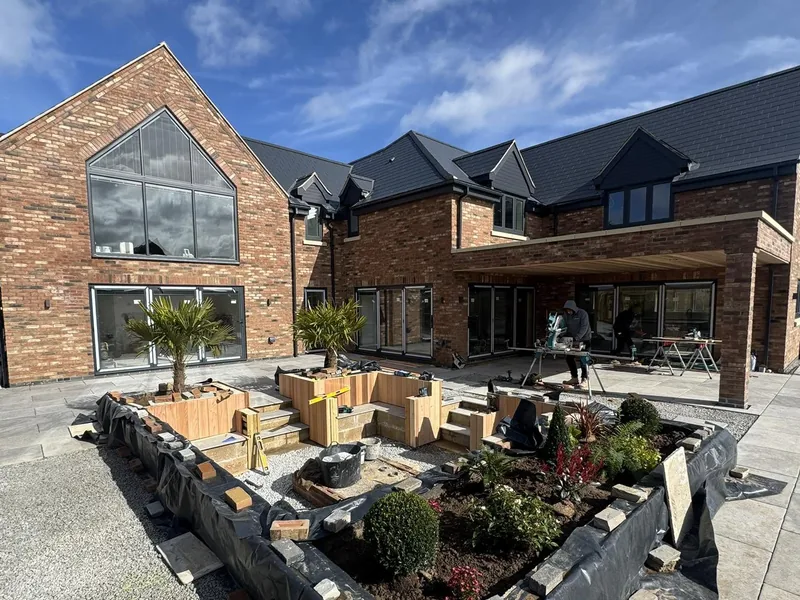
A garden fire pit structure cloaked in western red cedar, part of a wider garden project that also included a 50 metre run of hit and miss batten fencing, with SSL resin bonding the pathways. Outdoor structures follow exactly the same rules as a house elevation: ventilated gap behind, stainless fixings, sealed end grain, boards clear of the ground.
How we fit cedar
The build-up is the same one we use on every external cladding job, because it is what decides how long the boards last. A vapour permeable breather membrane on the wall, UV stable facade grade if the cladding is open jointed. Treated softwood battens over it, typically 38 x 25mm or 50 x 25mm at 400 to 600mm centres to suit the board. Counter-battens wherever boards run vertically, so the cavity drains rather than damming behind a horizontal batten. A cavity of at least 25mm, open at the base and at the head, with insect mesh at the openings.
Then setting out. Coursing is planned from the window and door openings so boards land properly at cills and heads rather than starting from a corner and finishing on a thin rip. Corners, internal and external, are decided before the first board goes up. Reveals get the cavity carried through with a detail that throws water clear of the boards below.
Boards are fixed at a moisture content close to service conditions, roughly 16 to 19 per cent, not straight off a wet pack. Face widths are kept sensible. Every cut end is sealed on site, and the cladding stops clear of the ground so splashback cannot sit against the timber.
Where the design calls for a coating, the honest advice is to coat all four faces before the boards go on the wall. Brushing the face after fixing leaves the back and the ends raw, which is where water gets in and where the coating starts to fail from.
Cedar or larch, quick answer
- Choose cedar
- Fine detailing, close joints, secret fix, stability matters, large elevations, coated finishes, low impact areas
- Choose larch
- Rough sawn look, tighter budget, hard wearing at low level, agricultural and workshop buildings, big coastal elevations
- Either
- Both silver if left uncoated. Both need a ventilated cavity and stainless fixings. Both are fine on the Norfolk coast with A4 fixings
For contractors and developers
Send the elevations and the specification and we will price the cedar package including membrane, battens, counter-battens, stainless fixings and trims. We have delivered to a national brand rollout specification, to architect's designs on high end domestic work, and inside full carpentry packages for main contractors. CHAS accredited, SMSTS certified, RAMS issued before we start, fourteen full-time carpenters so multiple elevations run at once.
For homeowners
Cedar is usually chosen for how it looks, so the useful conversation is about how it will look in five years and whether you want to maintain a colour or let it silver. We will tell you straight, including when a cheaper timber would do the same job on a sheltered elevation. One point of contact, free site visit, written estimate before anyone lifts a tool.
Common questions
Cedar cladding, answered
Why does cedar cladding need stainless steel fixings?
Western red cedar contains natural acids and extractives that corrode ordinary steel and eat through galvanised coatings. The fixing rusts, loses its grip, and bleeds a black tear stain down the board under every head. Stainless steel avoids all of it: A2 grade 304 inland and A4 grade 316 on coastal or heavily exposed elevations. It is not a premium option on cedar, it is the only correct one.
How durable is western red cedar without treatment?
Western red cedar heartwood is classified as durable, so it does not need preservative treatment for external use above ground. What it does need is the same ventilated cavity build-up as any other timber. Sapwood is a different matter and is not durable, which is one reason grade matters when you are buying it.
Will cedar cladding go silver grey?
Yes, if it is left uncoated. Cedar starts a warm reddish brown and weathers to a silver grey, unevenly at first, faster on south and west elevations and slower where soffits and projections shelter the boards. Many designs specify exactly that. If you want to keep the colour, a UV stable pigmented oil applied to all four faces before fixing will hold it, but it needs recoating, typically every two to three years.
Is cedar better than larch for cladding?
Different, not better. Cedar is more durable, much more dimensionally stable, lighter, cleaner grained and easier to coat, which suits fine, close-jointed and secret fixed detailing. Larch is denser, tougher against knocks, cheaper and has more character, which suits rough sawn, agricultural and hard-wearing elevations. Cedar is soft and dents more easily, so at low level on a busy elevation larch often makes more sense.
Can cedar cladding be used on a garden room or fire pit structure?
Yes, and it is one of the most common uses we get asked for. We clad a garden fire pit structure in western red cedar for SSL Home Creations alongside a 50 metre run of hit and miss batten fencing. The same rules still apply outdoors: a ventilated gap behind the boards, stainless fixings, end grain sealed, and boards kept clear of the ground and splashback.
How much maintenance does cedar cladding need?
If you let it silver, almost none: an annual look over the fixings, a check that the cavity vents at the base and head are clear, and a wash down. If you are holding a colour with a translucent oil, expect to recoat every two to three years, and sooner on an exposed seaward elevation. Either way, keep vegetation off the boards and keep the base clear so splashback does not sit against the timber.
Thinking about cedar?
Send the elevations and we will price the package, fixings and cavity included, and tell you how it will weather.