
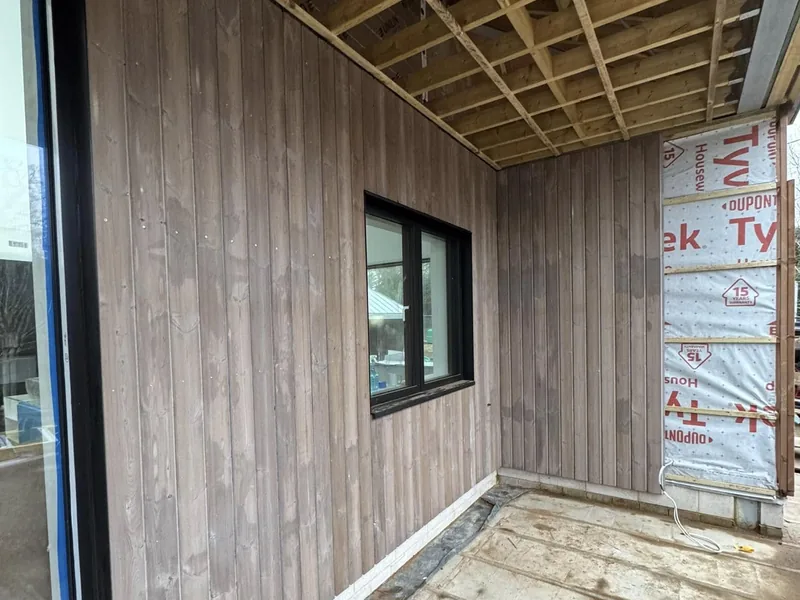
Cladding · Timber
Timber cladding installation
Timber cladding installed across Lincolnshire, Cambridgeshire and Norfolk, on houses, extensions, new builds, workshops and commercial units. We will tell you which species suits your elevation, how it will weather, and what maintenance you are actually signing up for. Free site visit and a written estimate.
Picking the species
Durability, movement and honesty about how it will look.
Timber species are classified for natural durability against decay, from very durable down to not durable, and only the heartwood counts. Sapwood in any species is effectively non durable. That single fact explains most premature cladding failures: boards cut with sapwood on the face, fitted with no treatment, on a wall with no cavity.
| Species | Natural durability, heartwood | Movement | Notes |
|---|---|---|---|
| Western red cedar | Durable | Small | Very stable, light, few defects, holds a coating well. Acidic, so stainless fixings only |
| Siberian larch | Moderately durable | Medium | Slow grown, dense, tight knots, hard wearing, very good value |
| Scottish and home grown larch | Moderately durable | Medium to large | More character, larger and looser knots, more resin and more movement |
| Douglas fir | Moderately durable | Medium | Available in long lengths, warm colour, needs care with resin pockets |
| European oak | Durable | Large | Superb life, expensive, tannins stain masonry and metal below |
| Treated softwood | Not durable untreated | Medium | Must be preservative treated to Use Class 3, external above ground |
| Modified timber | Very durable | Very small | Acetylated and thermally modified boards, stable and long lived, premium cost |
Two practical points follow from that table. First, if you are cutting boards on site, the cut ends are raw and need sealing, whatever the species. Second, if you are using a treated softwood, every cut exposes untreated timber, so end grain preservative on site is not optional.
Movement, cupping and board width
Timber moves across the grain as moisture content changes, not along it. That means wide flat sawn boards cup, and the wider the board the worse it gets. Keep face widths sensible, around 125 to 150mm for a face fixed board, and fix boards at a moisture content close to what they will live at in service, roughly 16 to 19 per cent for external cladding, rather than straight off a wet pack in February.
Fixing pattern matters as much as width. Boards up to about 100mm face width take a single central fixing per batten, which lets the board move around it. Wider boards take two, positioned so the board can still move rather than being clamped at both edges. Pin a wide board hard at both edges and it will split rather than cup, which is worse.
Timber cladding specification
- Profiles
- Feather edge, shiplap, tongue and groove, board on board, square edge open jointed, rough sawn or planed
- Orientation
- Horizontal, vertical or diagonal. Vertical always needs counter-battens
- Battens
- Treated softwood, typically 38 x 25mm or 50 x 25mm at 400 to 600mm centres
- Cavity
- 25mm minimum, ventilated and drained top and bottom, insect mesh at openings
- Membrane
- Vapour permeable breather membrane, UV stable facade grade behind open jointed boards
- Fixings
- A2 stainless inland, A4 stainless on the coast, penetrating the batten by at least 2.5 times board thickness
- Moisture
- Boards fixed at roughly 16 to 19 per cent moisture content
- End grain
- Sealed on every cut, on site, before the board goes up
Fixing method
Secret fix or face fix
Secret fixing
The fixing goes through the tongue of a tongue and groove board, or into a proprietary clip, and is then covered by the next board. Nothing is visible on the face, which is why architects like it and why it suits a clean modern elevation.
The trade-offs are real, though. Board width is limited, because a secret fixed board is restrained on one edge and has to be narrow enough that movement does not tear the tongue. It is less forgiving on exposed elevations. And replacing a damaged board in the middle of an elevation means working back to it, which turns a one board repair into an afternoon.
Face fixing
Stainless ring shank nails or stainless screws driven through the face into the batten. The fixings are visible, in a regular pattern, and on rough sawn boards that reads as honest rather than untidy.
It is stronger, copes with wider boards and higher exposure, and any single board can be lifted and replaced years later without disturbing its neighbours. On coastal work, on rough sawn boards and on anything that will need maintaining, this is normally what we recommend, and it is what we used on 111 square metres of rough sawn 6x1 cladding at Alford.
Detailing is where jobs are won or lost
The boards in the middle of an elevation are straightforward. The life of the job is decided at the edges: the base, where the cladding must stop clear of the ground and splashback and the cavity must stay open; the head, which needs a ventilated exit for the cavity air; window and door reveals, which need the cavity carrying through and a detail that throws water clear of the boards below; corners, internal and external, which need to be planned before the first board goes on; and the junction with the roof, where the cladding has to stop somewhere sensible rather than being scribed to a tile.
Setting out follows the same logic. Coursing is planned from the openings so boards land properly at cills and heads, rather than starting at one corner and finishing on a 20mm rip at the other.
Coating, silvering and maintenance
Preservation and appearance are two separate decisions and they get muddled constantly. Preservation is about whether the species can survive outside: durable heartwood such as cedar or oak needs nothing, and non durable softwood must be preservative treated to Use Class 3 for external use above ground. Coating is about what colour you want it to be.
Leave it. All timber silvers under UV, unevenly, fastest on south and west elevations and slowest where a soffit or projection shelters the boards. Plenty of architects specify exactly this, and it is the lowest maintenance route: an annual look at the fixings and the cavity vents, and nothing else.
Coat it. A UV stable pigmented oil or an opaque coating will hold a colour, but only if it is maintained. Translucent oils typically need recoating every two to three years, sooner on an exposed seaward elevation, and opaque coatings last longer but fail more visibly when they do. Coat all four faces before fixing rather than brushing the face afterwards, because the back and the ends are where water gets in.
Do not use clear varnish outside. UV gets through it, degrades the timber underneath, and the film then lifts in sheets. Stripping it back is a far worse job than maintaining an oil would have been.
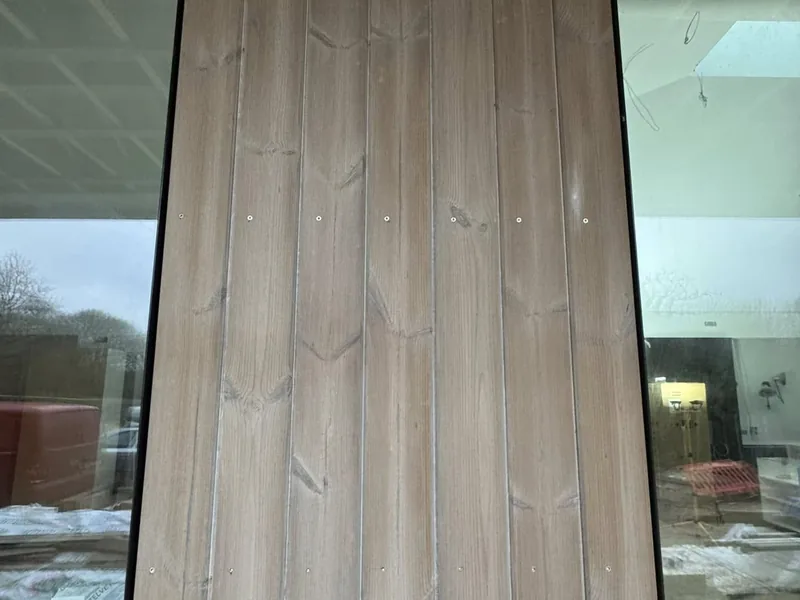
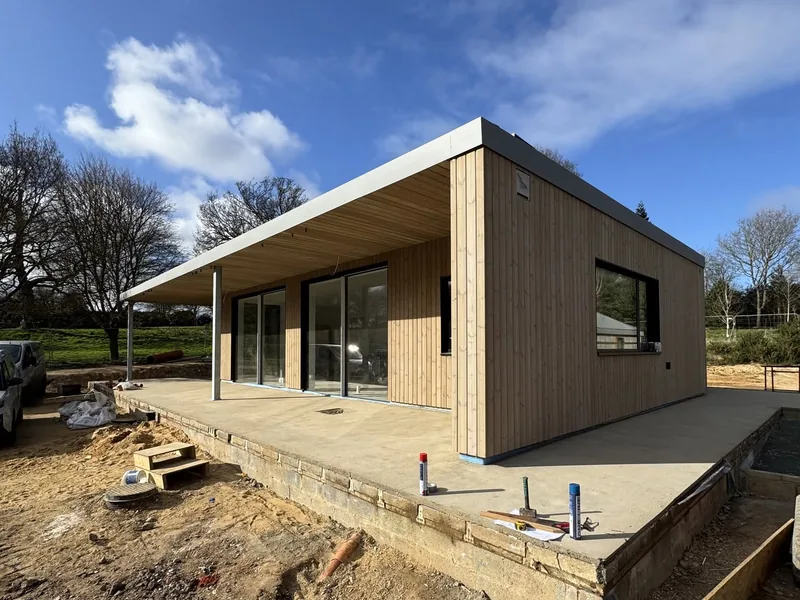
At Alford, on a new events hall and workshop for Probus Construction, the boards went up in natural timber with a protective black paint coating so the buildings would sit quietly against the surrounding properties. That is a coating decision made for planning and context, not for protection, and it is a good example of the two questions being answered separately.
Where timber is restricted
- Height rule
- Combustible materials are restricted in the external walls of relevant buildings at and above 11 metres in England
- Building types
- Dwellings, care homes, hospitals, student accommodation, hotels, hostels and boarding houses
- Usual answer
- Fibre cement board or a mineral cored panel system. We fitted cement board cladding on an extension at Long Sutton
- Whose call
- Your designer or building control, not your carpenter. We fit to the specification and flag anything that looks wrong
For contractors and developers
Send elevations and a specification and we will price the timber cladding package including membrane, battens, counter-battens, fixings and trims, or take it inside a wider carpentry package. CHAS accredited, SMSTS certified, RAMS before we start, fourteen full-time carpenters so several elevations can run at once. We have worked to architect's designs on high end domestic, to a council-overseen programme at Alford, and to a national brand's rollout specification for Costa.
For homeowners
One point of contact and a written estimate before anything starts. The most useful part of a site visit is usually the conversation about what the boards will look like in five years, because that is the thing nobody tells you at the merchant. If the cladding is part of an extension or renovation we can cover the rest of it too, with our own trades.
Common questions
Timber cladding, answered
Which timber is best for external cladding in the UK?
Western red cedar heartwood is classed as durable and is the most dimensionally stable common choice. Larch, both Siberian and home grown, is moderately durable, harder wearing and better value, with more knots and more movement. European oak heartwood is durable but expensive and stains anything it runs onto. Douglas fir sits between larch and cedar. Untreated softwood sapwood is not durable at all and must be preservative treated for external use above ground. The right answer depends on exposure, budget and whether you want the boards to silver.
Should timber cladding be secret fixed or face fixed?
Secret fixing, through the tongue of a tongue and groove profile or with a clip system, gives a clean face with no visible fixings, but it limits board width, is less forgiving of movement and makes replacing a damaged board mid-elevation awkward. Face fixing with stainless ring shank nails or screws is stronger, copes better with wide boards and exposure, and lets a single board be swapped later. On exposed and coastal elevations we normally recommend face fixing.
How much movement should be allowed for in timber cladding?
Timber moves across the grain with moisture content, so boards need to be fixed at a moisture content close to the conditions they will live in, roughly 16 to 19 per cent for external cladding, and fixed in a way that lets them move rather than restraining them. Keep face widths sensible, around 125 to 150mm for a face fixed board, use a single central fixing per batten up to about 100mm wide and two on wider boards, and never pin a board tight at both edges.
Do you have to treat or coat timber cladding?
Durable heartwood species such as cedar and oak do not need preservative treatment. Non durable softwoods do, to Use Class 3 for external use above ground. Coating is a separate decision from preservation: it is about appearance. Left uncoated, all timber silvers. If you want to hold a colour, use a UV stable pigmented oil or opaque coating, apply it to all four faces before fixing rather than brushing it on afterwards, and plan to recoat. Clear varnish outdoors will fail.
How long does timber cladding last?
With a correct ventilated cavity build-up, stainless fixings, sensible detailing and a durable or treated species, decades. Without a ventilated cavity, far less, whatever the species. The build-up and the detailing behind the boards decide the life of the job much more than the timber does, which is why we price membrane, battens and counter-battens as part of the work rather than as an optional extra.
Can you clad over an existing wall?
Usually yes, provided the wall is sound, dry and can carry the battens, and provided you are not covering something that needs fixing first. The cladding still needs a breather membrane, treated battens, counter-battens where boards run vertically and a ventilated cavity, and the detailing at eaves, cills, reveals and the base has to be worked out so water is thrown clear. We will look at the wall before quoting rather than assuming.
Not sure which timber to use?
Send us the elevations, or we will come and look at the exposure and tell you straight.