
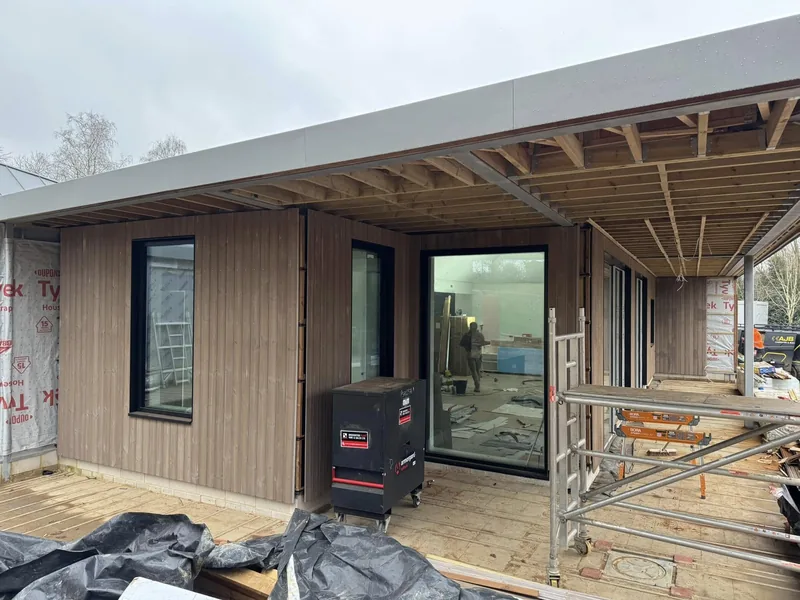
Cladding · Siberian and Scottish larch
Siberian and Scottish larch cladding
Larch cladding installed across Lincolnshire, Cambridgeshire and the Norfolk coast, including over 350 square metres of Scottish larch at Cromer. Dense, hard wearing, good value timber, fitted on a ventilated cavity with stainless fixings so it lasts. Free site visit and a written estimate.
Choosing the larch
Same species name, two quite different boards.
Larch is the workhorse of British cladding. Its heartwood is classified as moderately durable, a step below cedar and oak but well ahead of untreated softwood, and it is dense enough to take knocks that would dent cedar. It costs less than cedar and it has more character. What you have to decide is where it grew.
| Siberian larch | Scottish and home grown larch | |
|---|---|---|
| Growth | Slow, in a hard continental climate | Faster, in a milder maritime climate |
| Density and rings | Denser, tight growth rings | Lighter, wider rings |
| Knots | Smaller, tighter, sounder | Larger, looser, more of them |
| Resin | Present but manageable | More resin, more bleed in the first year or two |
| Movement | Medium, more predictable | Medium to large, needs more allowance |
| Best for | Fine, close-jointed and coated elevations | Rough sawn, rustic, agricultural and large elevations |
| Supply chain | Long, imported | Short, UK grown |
Neither is wrong. Siberian is the safer specification where joints are close, the boards are planed and the elevation has to look precise. Home grown larch is the honest, characterful board with a much shorter supply chain, and it is what we fitted on over 350 square metres at Cromer.
Movement, cupping and how boards are fixed
Larch moves more than cedar. That is not a problem, it is a specification input. Keep face widths sensible, around 125 to 150mm for a face fixed board. Fix at a moisture content close to service conditions, roughly 16 to 19 per cent, not straight off a wet pack. Use a single central fixing per batten on boards up to about 100mm face width, and two on wider boards, positioned so the board can move around the fixing rather than being clamped at both edges. A board that is pinned hard at both edges splits, which is harder to live with than a board that cups slightly.
Larch is also resinous, so expect some bleed from knots in the first couple of seasons, especially on south facing elevations in a hot summer. It weathers off.
Larch cladding specification
- Durability
- Heartwood classified as moderately durable. Sapwood is not durable, so grade and specification matter
- Hardness
- Dense and tough. Handles knocks at low level far better than cedar
- Profiles
- Rough sawn square edge, feather edge, shiplap, tongue and groove, board on board, open jointed
- Fixings
- A2 stainless inland, A4 grade 316 stainless on the Norfolk coast and exposed elevations
- Battens
- Treated softwood at 400 to 600mm centres, counter-battened where boards run vertically
- Cavity
- 25mm minimum, ventilated and drained top and bottom, insect mesh at openings
- Moisture
- Fixed at roughly 16 to 19 per cent moisture content
- Weathering
- Honey brown to silver grey, unevenly for the first two to three years
The Norfolk coast
350 square metres of Scottish larch at Cromer
Cromer is about as hard an exposure as this part of the country offers. Salt-laden wind off the North Sea, driving rain arriving at pressure, and full UV on the seaward elevations. We were contracted to fit over 350 square metres of Scottish larch on a new build there, and everything about the specification was set by that exposure rather than by the drawing.
What changes on a coastal job: A4 grade 316 stainless fixings rather than A2, because salt air will find any lesser fixing and stain the boards under every head. Generous cavity ventilation, because the wall behind has to be able to dry after every storm. End grain sealed on every single cut, because that is where water enters a board. Any coating applied to all four faces before the boards go up, not brushed on afterwards. And a preference for a design that accepts silvering rather than one that depends on a coating staying perfect for a decade in salt spray.
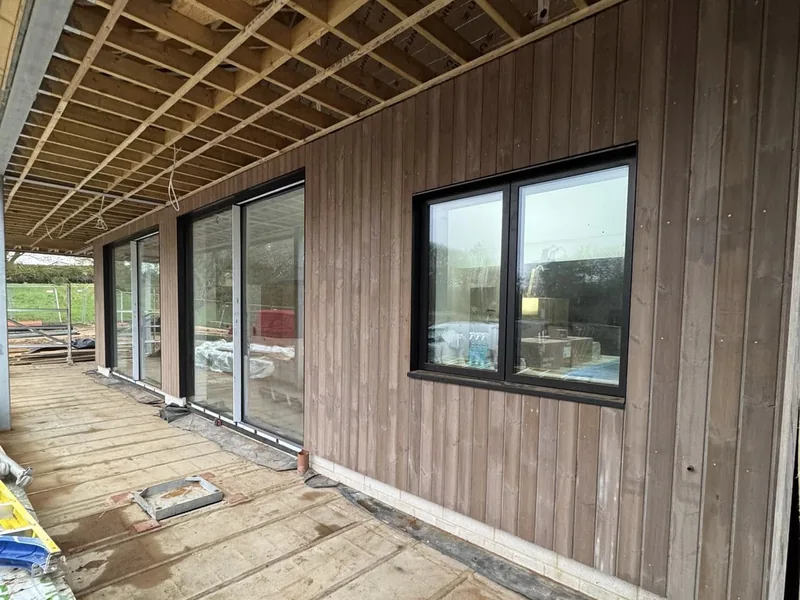
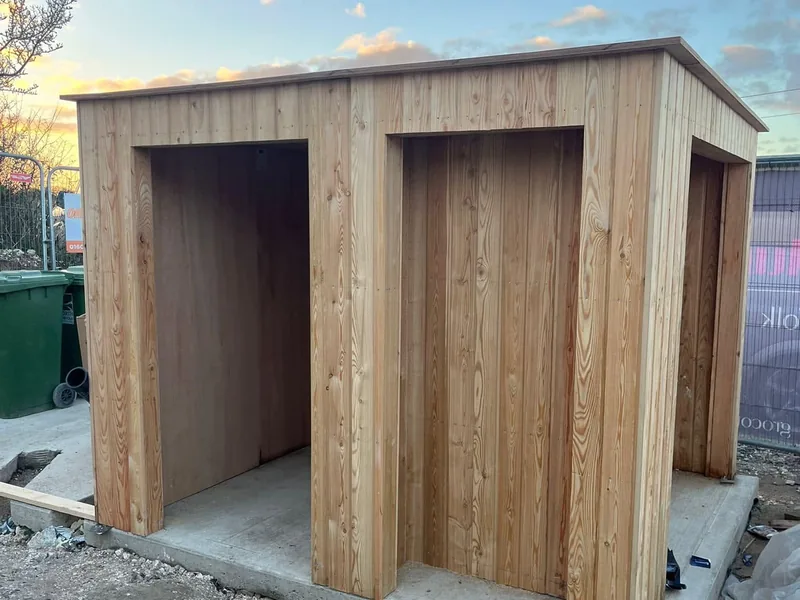
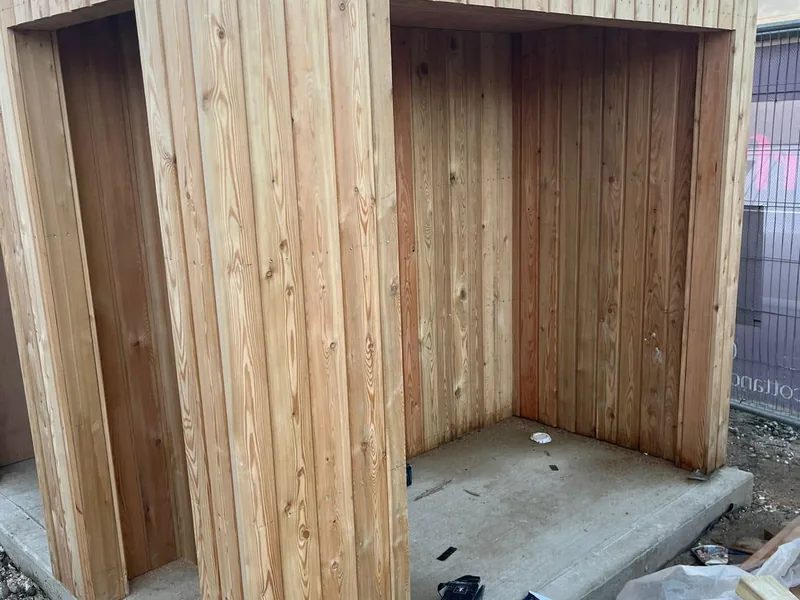
Along the same coast, at Wells-next-the-Sea, we took the exterior finish package on Snuggle Cottage, a build of circa £1.8M. That included full exterior cladding on both properties and a sea-view watch tower machined up on site by our joiners from packs of loose sawn Scottish larch, lined internally with PIR board, battened out and finished in oak faced cladding so it can be used all year round. Machining boards on site from loose sawn packs is not a normal cladding job, and it is a fair demonstration of what our joiners can do when the architect's plan is, in our own words at the time, questionable.
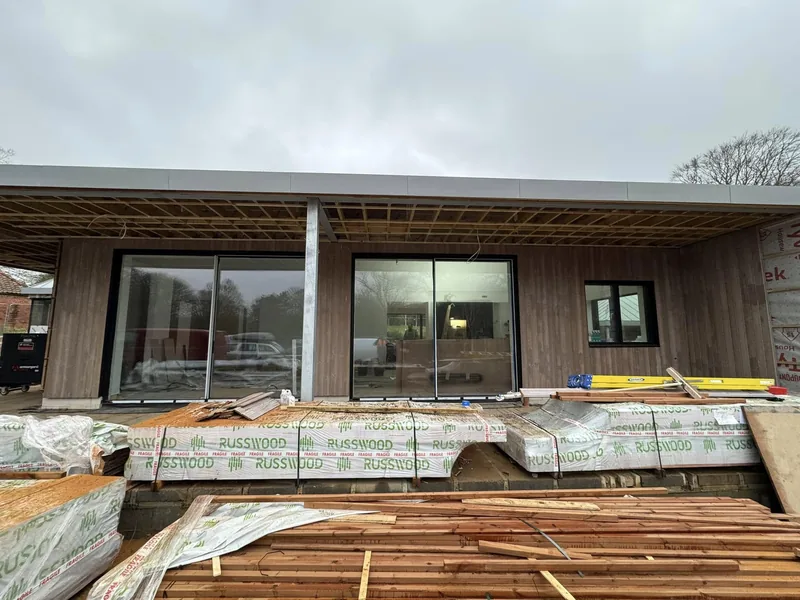
What it will look like
Silvering, patchiness and the coating decision
Larch does not weather politely. It starts a warm honey brown, and it silvers to grey over roughly two to three years, but it gets there unevenly. The south and west elevations move fastest. Anything under a soffit, an overhang or a deep reveal stays browner for longer. Rain runs off the same lines on the same elevations every time, so the streaks follow the geometry of the building. Add resin bleed from knots in the first summer or two and the honest description of years one and two is patchy.
Most people who have seen a mature larch elevation are happy with that, because the end state is a good one and it needs almost nothing done to it. But it is worth knowing in advance, because a client who was expecting a uniform colour on day one will be unhappy in month eight.
The alternative is to coat it. A UV stable pigmented oil or an opaque coating will hold a colour, applied to all four faces before fixing. Translucent oils typically need recoating every two to three years, sooner on an exposed seaward elevation. Opaque coatings last longer but fail more visibly. What does not work outside is clear varnish: UV gets through it, degrades the timber underneath and the film then lifts in sheets.
At Alford, on an events hall and workshop for Probus Construction, we installed 111 square metres of rough sawn 6x1 cladding in natural timber with a protective black paint coating, chosen so the new buildings would blend with the surrounding properties. That is a coating decision driven by context rather than protection, and it is a good example of deciding the appearance question separately from the durability one.
Ongoing maintenance, honestly. Uncoated: an annual walk round, check the fixings, check the cavity vents at base and head are clear, wash down, keep vegetation off. Coated: the same, plus recoating on the manufacturer's cycle. Either way, keep the base of the cladding clear so splashback is not sitting against the timber, and deal with a damaged board when you notice it rather than in three years.
For contractors and developers
Send elevations and a specification and we will price the larch package including breather membrane, treated battens, counter-battens, stainless fixings and trims, or take it inside a wider carpentry package. We have delivered larch at scale on an exposed coastal site, machined boards on site from loose sawn packs on a high value private build, and worked to council-overseen programmes in Lincolnshire. CHAS accredited, SMSTS certified, RAMS before we start, fourteen full-time carpenters.
For homeowners
Larch is usually the sensible answer when you want a real timber elevation without cedar money, and it is tough enough to live with on a busy house. The conversation worth having on site is about silvering: whether you want to let it happen or hold a colour, because that decision changes both the specification and what you will be doing in three years. Free site visit, written estimate, one point of contact.
Common questions
Larch cladding, answered
What is the difference between Siberian larch and Scottish larch?
Siberian larch grows slowly in a hard climate, so it is denser, the growth rings are tighter, the knots are smaller and sounder, and the board is more stable. Scottish and other home grown larch grows faster, so it has bigger and looser knots, more resin, more character and more movement. Siberian is the safer choice for a fine, close-jointed elevation. Home grown larch suits rough sawn and rustic work, has a much shorter supply chain, and is what we used on over 350 square metres at Cromer.
Is larch durable enough for coastal cladding?
Larch heartwood is classified as moderately durable, which is a step below cedar and oak but well ahead of untreated softwood. On the Norfolk coast it performs well provided the build-up is right: a properly ventilated and drained cavity, A4 grade 316 stainless fixings, end grain sealed on every cut, and boards kept clear of the ground and splashback. Sapwood is not durable, so grade and specification matter.
Does larch cladding move a lot?
More than cedar, less than oak. Larch is dense and resinous and will cup if boards are too wide or fixed too wet, so keep face widths sensible, fix at a moisture content close to service conditions of roughly 16 to 19 per cent, and use a single central fixing per batten on narrow boards or two on wider ones so the board can move rather than split. Home grown larch moves more than Siberian.
Will larch cladding silver evenly?
Not at first. Larch weathers from a warm honey brown to silver grey, and it silvers unevenly, faster on south and west elevations and slower under soffits, overhangs and reveals. Resin bleed from knots can also show for the first year or two. Most elevations even out over about two to three years. If patchiness during that period would bother you, coat it from the start with a UV stable pigmented finish.
Can larch be face fixed or does it need secret fixing?
Face fixing with stainless ring shank nails or screws is usually the better answer for larch. It is stronger, copes with the extra movement, suits rough sawn boards where a regular fixing pattern reads as honest detailing, and lets a single damaged board be replaced later without stripping back to it. Secret fixed tongue and groove is possible in larch but it restricts board width and is less forgiving on exposed elevations.
How big a larch cladding job will you take on?
From a single elevation on a domestic extension up to whole buildings. The largest we have delivered is over 350 square metres of Scottish larch on the Norfolk coastline at Cromer. We also machined a sea-view watch tower on site at Wells-next-the-Sea from packs of loose sawn Scottish larch, as part of the exterior finish package on a build of circa £1.8M.
Larch on an exposed elevation?
Send the elevations. We will price it properly, fixings, cavity and coastal detailing included.