
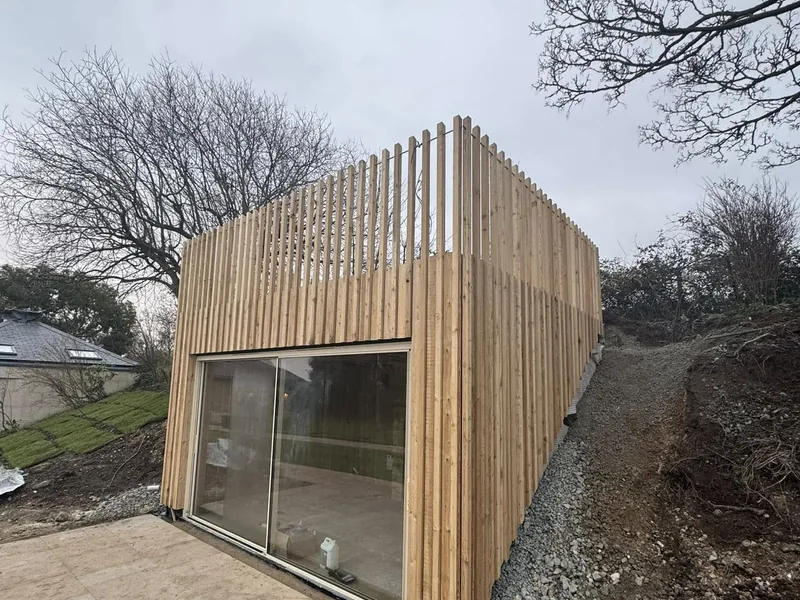
Snuggle Cottage, Wells-next-the-Sea
Twenty two miles east. The exterior finish package on a circa £1.8M build: full cladding to both properties, plus a sea view watch tower machined on site from loose sawn Scottish larch.
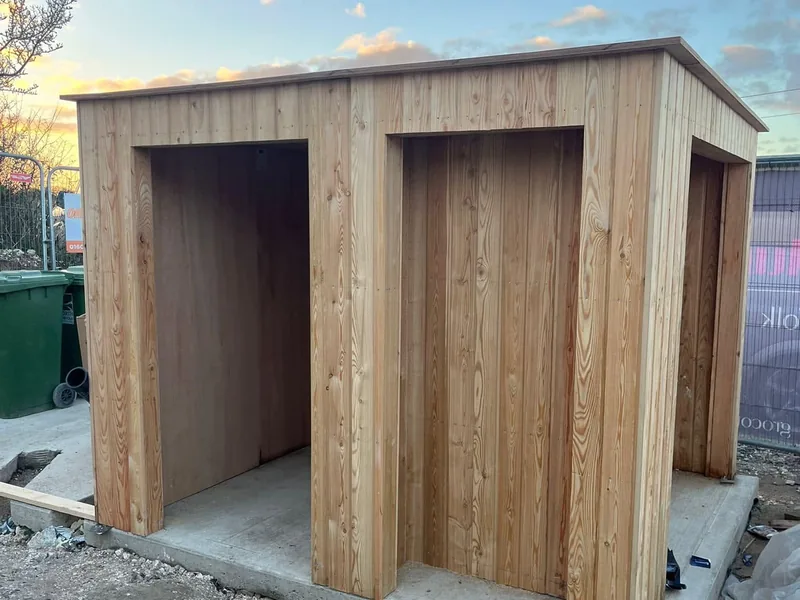
Cladding · Hunstanton, west Norfolk
Cladding installers covering Hunstanton and the west facing Norfolk coast, working along this coastline from Wells-next-the-Sea and Cromer. Free site visit and a written estimate that specifies what goes behind the boards.
Straight answer first: AJB Group has not clad a building in Hunstanton. The nearest completed coastal work is at Wells-next-the-Sea, about 22 miles east along the A149, and at Cromer further round, where over 350 square metres of Scottish larch went on a new build.
Those are the two references, and they are real. AJB takes cladding work along this whole coastline, and if you are weighing us up against someone with a Hunstanton job to show you, that is a fair thing to put in the balance. What follows is the useful part instead: what this particular stretch of coast does to a clad building, and what should be specified because of it.
The Hunstanton problem
Hunstanton is the odd one out on the east coast of England: it looks west, out across the Wash, rather than east into the North Sea. That single fact changes how a clad elevation behaves here compared with Wells, Blakeney or Cromer.
On most of the Norfolk coast the weathering face and the sun face are different walls. The north and east elevations take the driving rain off the sea, and the south and west elevations take the sun. You can specify accordingly: a tougher build up and a shorter maintenance interval on one side, a lighter touch on the other.
In Hunstanton they are the same wall. The prevailing south westerly and westerly weather comes in off the Wash and lands on the seaward elevation, and so does the afternoon and evening sun. That elevation gets wind driven rain, salt loading, UV and the fastest wetting and drying cycle on the building, all in one place. It silvers first, it breaks a coating down first, and it moves most.
The second Hunstanton condition is fetch. There is nothing between the building and the far side of the Wash. No trees, no rising ground, no shelter. Wind pressure on the boards and pressure differentials across the cavity are higher here than on a comparably distant inland site, which argues for tighter fixing centres, boards fixed to move rather than restrained, and a cavity that is genuinely open at the base and at the head so it can equalise and drain.
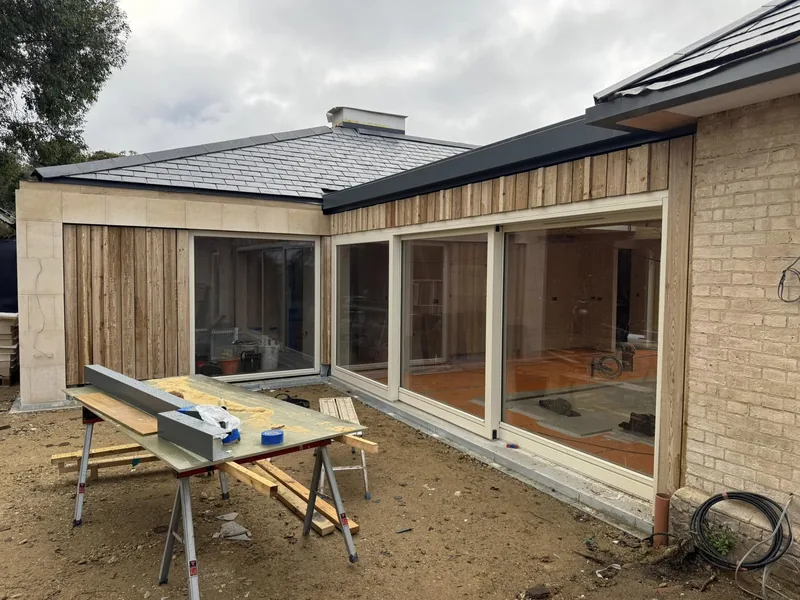
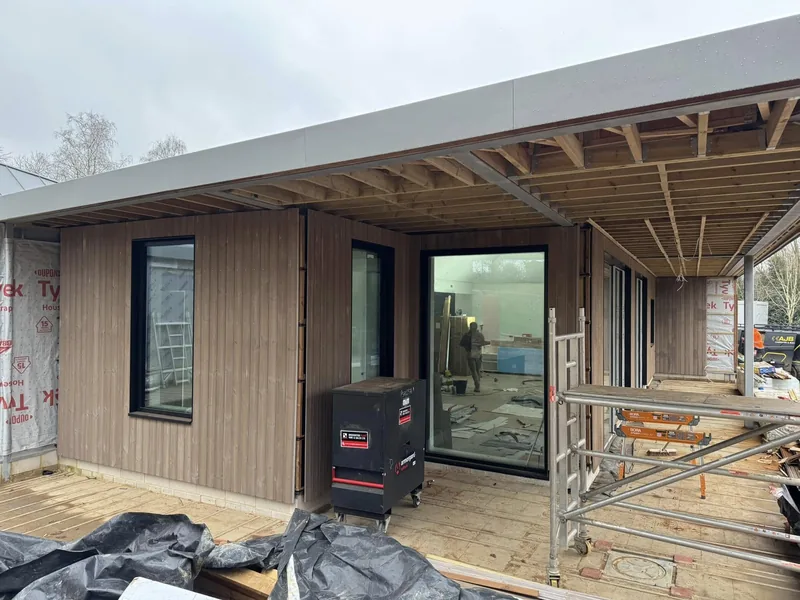
Materials
Larch. Scottish and Siberian larch are dense and moderately durable, and larch is what AJB has used most on this coast, including all 350 square metres at Cromer. It has more character than cedar and more movement with it, so the fixing pattern has to allow the boards to work.
Western red cedar. Very stable, light for its size, durable heartwood, and easier to work on a tall elevation. It is softer than larch, so it takes knocks more easily at ground level, and its natural acids attack anything that is not stainless.
Thermally modified timber. Heat treated rather than chemically treated, more dimensionally stable and more durable than the softwood it started as. It is a sensible answer where a building is a holiday let and nobody will be up a ladder with a brush.
Composite. Wood plastic composite gives consistent colour and almost no maintenance, which is why it turns up on coastal lodges and holiday accommodation. It is unforgiving about expansion gaps and fixing method, and on a west facing wall with a big daily temperature swing that is a real consideration rather than a footnote.
uPVC and shiplap. Cheapest to own and effectively maintenance free, and it needs proper allowance for thermal movement. Shiplap is a profile rather than a species: a rebated lap that sheds water and lets boards move, available in timber or plastic.
Design and planning
Hunstanton's own building material is carrstone, the warm brown sandstone quarried locally, and the Victorian resort core is carrstone and red chalk. Timber cladding is a newcomer in that context, which is not an argument against it, but it is an argument for where you put it. On new build, extensions, garden rooms, annexes and lodges it reads perfectly well. Applied across a Victorian frontage on the green it usually does not.
On planning, the position is worth checking before you get a quote rather than after. Cladding the outside of a dwelling with timber, plastic, render, stone, artificial stone, pebble dash or tiles is excluded from permitted development on land in a conservation area, a National Landscape, a National Park, the Broads or a World Heritage Site. Parts of Hunstanton lie in a conservation area, and the coast either side of the town falls within the Norfolk Coast National Landscape. The planning authority is the Borough Council of King's Lynn and West Norfolk, and a pre application enquiry is cheap compared with taking a wall back off.
One more local reality: a large share of the building stock here is holiday accommodation, and the maintenance budget after handover is often nil. That should push the specification towards a board that is designed to be left alone. Accepting a silvered finish, or choosing thermally modified timber or composite, is a more honest answer for a let than specifying a coated softwood that needs a cycle nobody will fund.
Getting to you
Hunstanton sits about 16 miles north of King's Lynn on the A149, and roughly 46 miles from AJB's base at Spalding, straight out on the A17 and then up the coast road. Wells-next-the-Sea, where the exterior finish package was completed, is about 22 miles east along the same A149.
That is a real distance and it is quoted as such. Cladding is package work with a defined start and finish, priced with the travel in it and programmed properly rather than dropped in around local jobs. AJB works King's Lynn constantly, has taken on Stoke Ferry Village Hall in Norfolk, and holds a fire door contract with North Norfolk District Council, so Norfolk is not an occasional excursion.
The nearest evidence
Twenty two miles east. The exterior finish package on a circa £1.8M build: full cladding to both properties, plus a sea view watch tower machined on site from loose sawn Scottish larch.
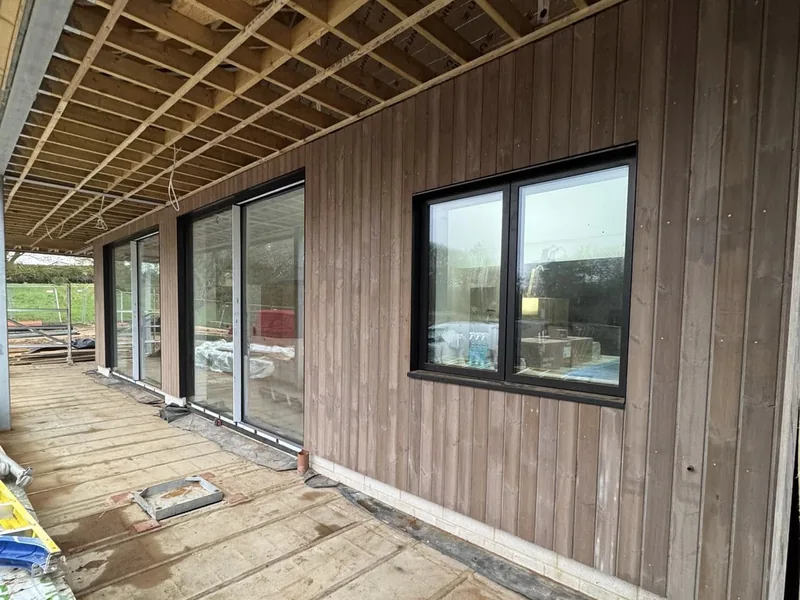
Over 350 square metres of Scottish larch on a new build, on the most exposed stretch of the Norfolk coastline that AJB works.
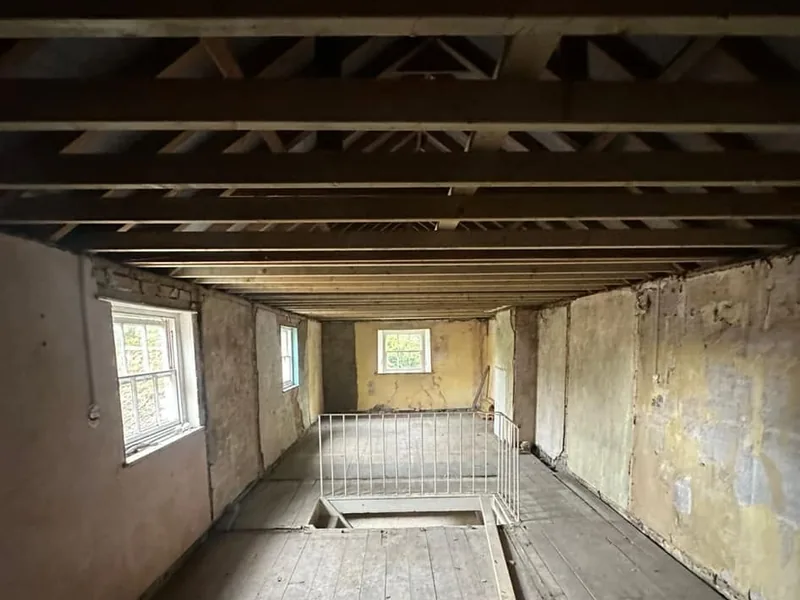
Sixteen miles south. A traditional joist set forming a new first floor in a tight building, then a complete first fix of floors, ceilings and external walls.
Common questions
No. We have no completed job in Hunstanton and we will not pretend otherwise. The nearest coastal cladding work is at Wells-next-the-Sea, about 22 miles east along the A149, and Cromer further round the coast, where we fitted over 350 square metres of Scottish larch. We take work along this whole coastline and can give references for both jobs.
Yes, and it is the one thing that makes Hunstanton different from every other resort on this coast. Because the town faces west across the Wash, the prevailing south westerly weather and the afternoon and evening sun land on the same elevations. Elsewhere on the Norfolk coast those are different walls. Here they are one wall, so silvering, coating breakdown and moisture cycling all run faster on it.
Possibly. Cladding the exterior of a dwelling is excluded from permitted development on land in a conservation area or a National Landscape. Parts of Hunstanton sit within a conservation area and the coast either side falls within the Norfolk Coast National Landscape, so check with the Borough Council of King's Lynn and West Norfolk before assuming permitted development applies.
A4 grade 316 stainless steel on exposed coastal elevations, rather than the A2 grade 304 that is acceptable inland. Airborne chlorides pit lesser fixings, which then bleed and leave a rust tear under every fixing head. With cedar and oak the natural acids in the timber attack ordinary and galvanised fixings as well, so stainless is not optional there either.
Faster than most owners expect, and unevenly. Untreated larch and cedar grey out under UV, and on a west facing seafront wall that is accelerated by both sun and salt. A sheltered elevation on the same building can stay warm brown for years. If an even colour matters, the answer is a pigmented UV stable coating with a maintenance cycle you will actually keep to, or a composite board.
No. Site visits and written estimates are free. On an exposed coastal elevation the visit matters more than usual, because the orientation, the exposure and the condition of the existing wall all change what should be specified behind the boards.
Free site visit, and an honest answer about whether cladding is the right call on that elevation.