
Guides · Cladding
Timber cladding species: larch, cedar, thermowood and more
There is no best cladding timber, only the right one for that elevation, that exposure and that budget. This is what actually separates the species, from the people who fit them.
Most cladding conversations start with the species and end with the price. That is the wrong order. Start with the exposure, then the movement you can live with, then how you want it to look in ten years, and the species almost picks itself.
Durability classes, and the sapwood trap
Timber durability is classified by BS EN 350 on a scale of 1 to 5, where class 1 is very durable and class 5 is not durable. It is a measure of natural resistance to fungal decay in the untreated heartwood only.
That last word is the one that catches people out. The sapwood of every species, including cedar and oak, is non-durable. A board sold as a durable species that contains a wide band of pale sapwood is not a durable board. When you specify, specify heartwood, and when the pack is delivered, look at it.
Durability class is also not the same as service life. A class 3 timber on a ventilated wall that dries after every shower will comfortably outlast a class 2 timber trapped against a damp wall with no cavity. Which is why the build-up behind the boards matters more than the label on the pack.
The species, honestly compared
| Species | Heartwood durability | Movement | Notes |
|---|---|---|---|
| Western red cedar | Durable (class 2) | Very low | Light, stable, easy to work, holds a coating well. Soft, so it marks. High tannin content, so stainless fixings only. |
| Siberian larch | Moderately durable (class 3) | Moderate | Slow grown, dense, tight knots. Hard wearing and good value for the durability. |
| Scottish and European larch | Moderately durable (class 3 to 4) | Moderate to high | Faster grown, more knots, more character, more movement to allow for. Short supply chain. |
| Douglas fir | Moderately durable (class 3 to 4) | Moderate | Available in long lengths, warm pinkish colour, resinous. Good for wide boards. |
| European oak | Durable (class 2) | High, and it moves for years | Very long lived, very heavy, very tannic. Expect staining below the boards until the tannins wash out. |
| Sweet chestnut | Durable (class 2) | Moderate | Oak-like appearance at lower weight. Prone to shake, so board lengths can be limited. |
| Thermally modified softwood (thermowood) | Improved by treatment | Low, notably improved | Heat treated with no chemicals. Rich brown through the section, silvers evenly. More brittle, so pre-drill near ends. |
| Acetylated softwood | Very durable | Very low | The most stable and longest lived softwood option, and the most expensive. Long coating intervals. |
| Treated redwood or whitewood | Not durable untreated, so preservative treated | Moderate to high | The budget option. Life depends entirely on the treatment specification and on cut ends being re-treated. |
Composite, shiplap profiles and uPVC are covered separately: see composite cladding, shiplap cladding and uPVC cladding.
Movement, cupping and board width
Timber moves across the grain with moisture content, and it moves roughly twice as much tangentially as radially. That difference is what makes a flat sawn board cup away from the heart side as it dries.
Three things reduce the problem. Narrower boards, because the same percentage movement over a smaller face is a smaller gap. Quarter sawn or rift sawn boards, because the growth rings run through the thickness rather than across the face. And fixing boards at close to their service moisture content rather than straight off a wet pack, which for external cladding in the UK means letting the timber acclimatise on site, stacked and stickered under cover, before it goes up.
The profile matters too. A shiplap or open jointed profile lets boards move behind the lap without opening a visible gap. A tight tongue and groove restrains movement, which is fine on a stable species and a problem on a lively one.
Evidence
What we actually fit, and where.
Larch is the timber AJB Group fits more than any other, and the Norfolk coast is where most of it goes.
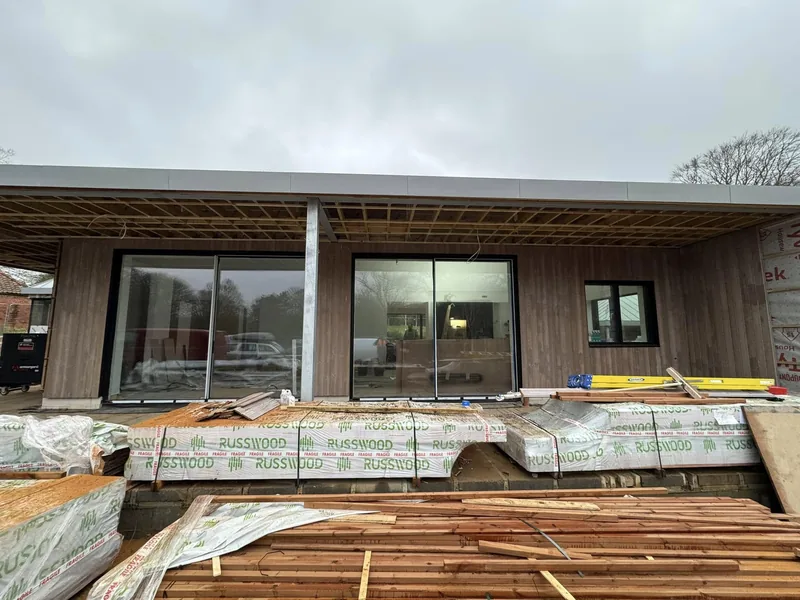
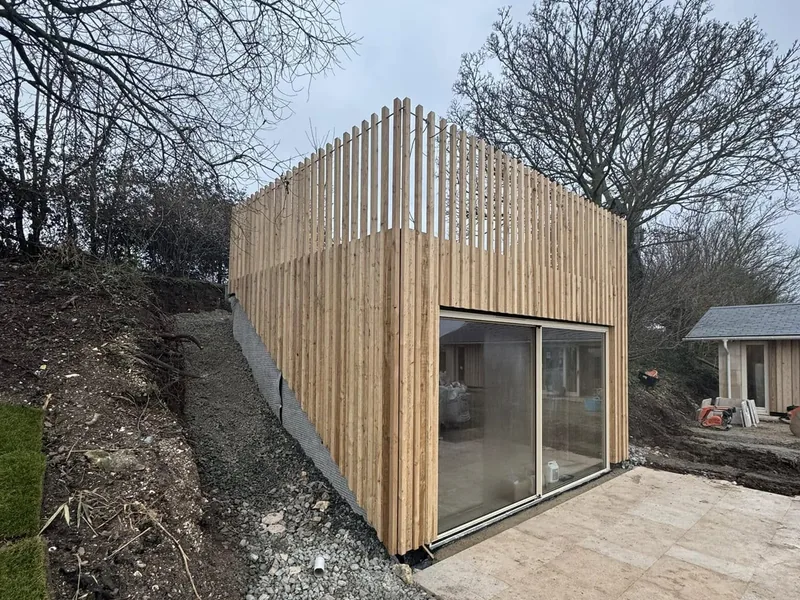
At Cromer, over 350 square metres of Scottish larch went onto a new build on the coastline. Exposure there is about as hard as it gets in this part of the country: salt-laden wind, driving rain off the North Sea and full sun on the seaward elevations. Larch takes it, and it silvers to a colour that suits the setting.
At Wells-next-the-Sea, the exterior finish package on a high end coastal build included a bird watching tower machined up on site from packs of loose sawn Scottish larch, insulated internally with PIR and battened out with an oak faced lining so it can be used all year.
At Alford Manor House the specification went the other way: rough sawn 6x1 boards across a new events hall and workshop, fitted in natural timber with a protective black coating so the new building sits quietly against the surrounding properties.
Specify these, every time
- Heartwood
- Sapwood is non-durable in every species, cedar and oak included
- Grade
- State it. Clear grade and sawn falling grade are different products
- Moisture
- Acclimatised on site before fixing, not straight off a wet pack
- Fixings
- A2 stainless inland, A4 stainless on coastal elevations
- Battens
- Treated softwood, counter-battened wherever boards run vertically
- Cavity
- 25mm minimum, drained and ventilated, insect mesh at openings
- End grain
- Sealed on every cut, including site cuts
- Ground clearance
- Boards stopped clear of splashback from paving or ground
Silvering: decide before, not after
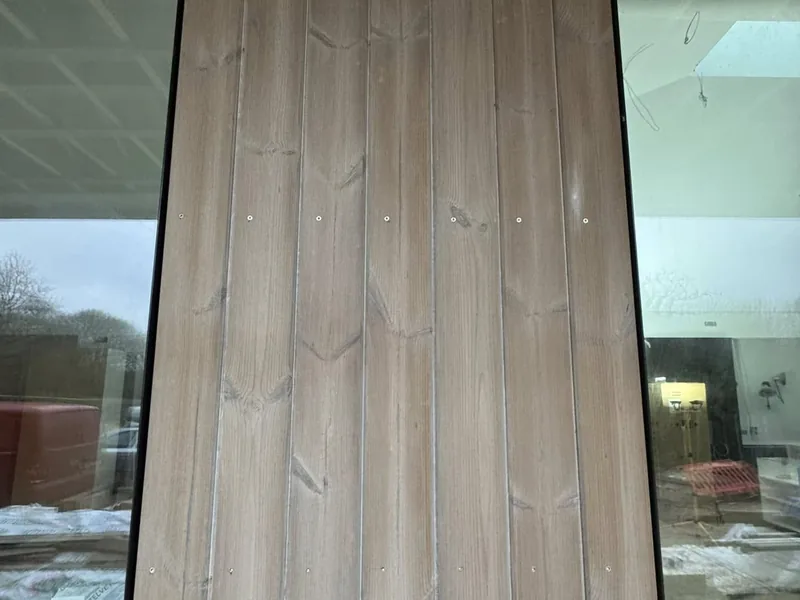
Left uncoated, timber weathers. Ultraviolet light breaks down lignin at the surface, rain washes the residue away, and the boards go silver grey. It is a surface effect, typically a fraction of a millimetre deep, and on a durable species it has no bearing on how long the cladding lasts.
What surprises clients is that it happens unevenly. Elevations that get sun and rain silver first. Boards under a deep eaves overhang, in a reveal, or behind a downpipe stay browner for years, because they get the ultraviolet without the washing. Rain shadow lines show up as darker streaks. On a building with varied exposure you will get a patchwork for the first few years before it evens out.
If that is a problem, there are three honest routes. Accept it and let it go grey. Use a penetrating pigmented oil, which fades gradually and can be recoated without stripping, and plan on recoating exposed elevations more often than sheltered ones. Or use an opaque coating, which lasts longest between coats but eventually fails at edges and end grain and needs proper preparation when it does. What we would avoid is a film forming clear varnish, which fails fastest of all in UV and then has to be stripped rather than refreshed.
Coastal and exposed elevations
Coastal work changes four things. Fixings move from A2 to A4 grade 316 stainless, because salt will find anything less. Ventilation matters more, not less, because wind driven rain gets behind boards that would stay dry inland. Coating cycles shorten, so budget for maintenance rather than hoping. And species stability becomes more valuable than species durability, because the thing that opens joints and pulls fixings on an exposed elevation is repeated wetting and drying, not decay.
The same logic applies to any fully exposed elevation, coastal or not. A south west facing gable on an open Fenland site is a harder environment than a sheltered north wall three miles inland.
Which timber for which elevation
- South and west, full exposure. Stability first: cedar, thermally modified softwood or Siberian larch. Expect the fastest colour change and the shortest recoat interval here.
- North elevations. These stay damp longest and are where algae and green staining appear. Ventilation and ground clearance matter more than species. Avoid a dark coating that shows bloom.
- Sheltered courtyards and under deep eaves. Almost anything works, but be aware these areas silver last and will look different from the rest of the building.
- Coastal. Larch, cedar or modified timber, A4 stainless fixings, generous cavity, and a maintenance plan.
- Low level, near paving. Stop the boards clear of splashback and use the most durable option you can afford. This is where cladding rots first, every time.
- Feature panels and entrances. Where a small area is on show, this is the place to spend money on a clear grade or a hardwood rather than on the whole building.
What drives the price
Species is only the first variable. Grade often matters more: a clear, knot free grade of the same timber can cost several times a sawn falling grade. After that come profile and machining, board lengths and the waste that short lengths create, secret fixing versus face fixing, how many openings, corners and changes of plane the elevation has, scaffold and access, and whether a finish is applied on site or bought pre-coated.
AJB Group prices cladding from the elevations and the specification rather than quoting a rate per square metre, because the same species on two different buildings is not the same job. Start at timber cladding, or go straight to larch cladding or cedar cladding.
On the boards
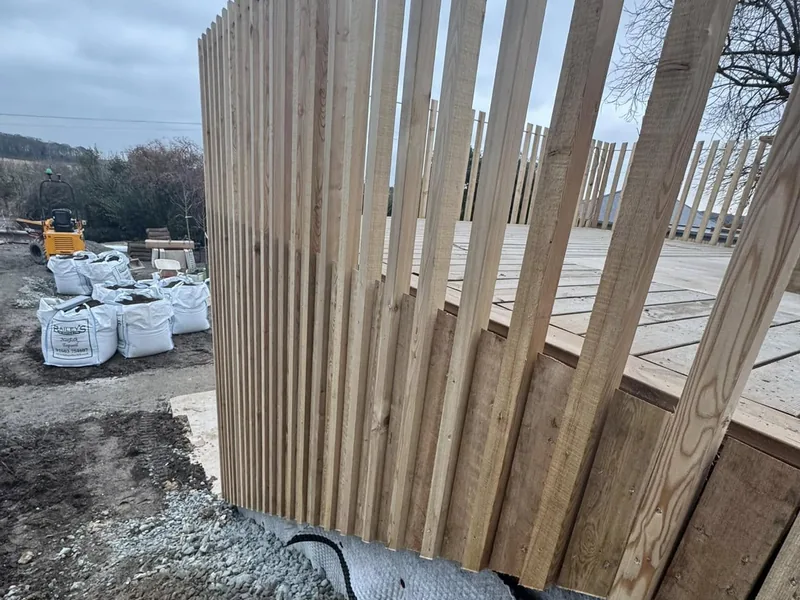
Larch, cedar and coated softwood, on our own jobs.
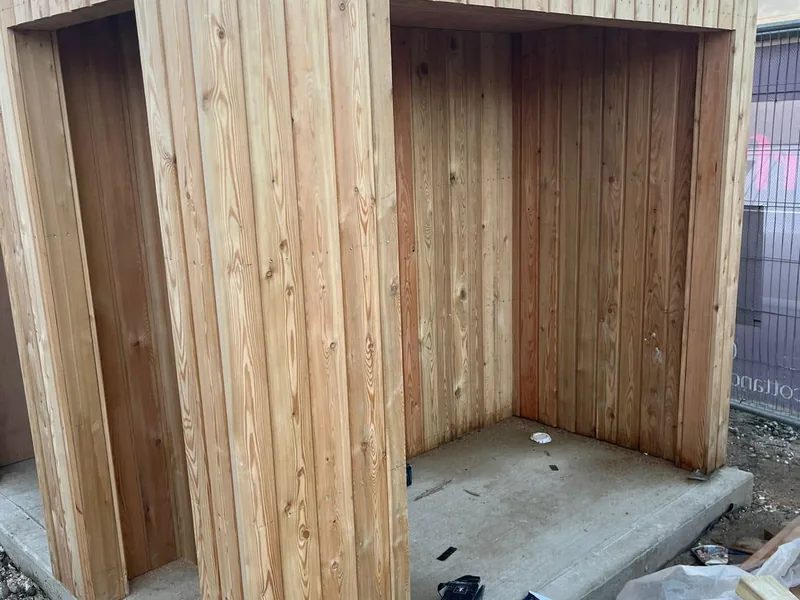
Every photograph on this site was taken on an AJB Group job. No stock imagery.
Common questions
Cladding species, answered
Which timber cladding lasts the longest?
On the timber alone, acetylated and thermally modified products and the durable hardwoods sit at the top, with cedar and oak close behind and untreated softwood at the bottom. In practice the build-up behind the boards decides the life of the job more than the species does. Cladding is a rainscreen, not a waterproof layer, so it needs a breather membrane, treated battens and a drained, ventilated cavity. A durable species on a badly detailed wall fails sooner than a modest species on a well detailed one.
What is the difference between Siberian and Scottish larch?
Growth rate, mostly. Siberian larch grows slowly in a cold climate, giving tight rings, denser timber, smaller knots and better stability. Scottish and other home grown larch grows faster, so wider rings, more knots, more character and a little more movement to allow for. Both are moderately durable in the heartwood. Home grown larch has a much shorter supply chain, and it is what we fitted at Cromer, over 350 square metres of it.
Do I have to coat timber cladding?
No, if you accept silvering. Left bare, durable timber weathers to silver grey, unevenly: sheltered areas under eaves and reveals stay browner for years. That is a finish decision, not a durability decision. To hold a colour, use a penetrating pigmented oil or an opaque coating and accept a recoating cycle, shorter on south and west elevations. Avoid film forming varnishes outside, because when they fail they peel and have to be stripped.
What fixings should be used on timber cladding?
Stainless steel. A2 grade 304 as a minimum inland, A4 grade 316 on exposed coastal elevations. Cedar and oak contain natural acids that attack ordinary and galvanised fixings, which corrode, bleed black tear stains down the boards and lose their grip. Fixings should penetrate the batten by at least around two and a half times the board thickness, with one central fixing per batten up to about 100mm face width and two above that.
Is timber cladding allowed on any building?
No, and check with the designer or building control before ordering. English building regulations restrict combustible materials in the external walls of relevant buildings above 11 metres, which rules timber out of many blocks of flats and similar buildings, and there are long standing limits on surface spread of flame for walls close to a boundary. On houses, extensions, workshops and low rise commercial buildings it is usually straightforward. Height, use and boundary distance decide it, not the material.
What drives the cost of a cladding job?
Species and grade first, since a clear knot free grade costs a multiple of a sawn falling grade in the same timber. Then profile and machining, board length and waste, secret or face fixing, how complicated the elevation is around openings and corners, access and scaffold, and whether the finish is applied on site or bought pre-coated. We price from the elevations and the specification, not from a rate per square metre.
Got elevations to clad?
Send the drawings and the exposure and we will tell you what we would use, and why.